Mar . 29, 2024 17:28 Back to list
Activated Carbon Filters activated charcoal water filter
Activated carbon filters are generally employed in the process of removing organic compounds and/or extracting free chlorine from water, thereby making the water suitable for discharge or use in manufacturing processes. Eliminating organics in potable water, such as humic and fulvic acid, prevents chlorine in the water from chemically reacting with the acids and forming trihalomethanes, a class of known carcinogens.
Activated Carbon (AC) filtration, as with any water treatment method, is not capable of removing every possible type of contaminant. For example, sodium, microbes, fluoride, and nitrates cannot be removed with AC filtration. Water softening also cannot be achieved with AC filters. In addition, heavy metals, such as lead, can only be removed with a very specific kind of activated carbon water treatment, which is typically used only in residential point-of-use filters.
High-Tech Filtration
There are many types of high-tech activated carbon filters available for industrial filtration systems. Activated carbon can exhibit varying performance characteristics depending upon the strata from which it is derived (e.g., bituminous or anthracite coal, bone char, coconut shell) and the way it is manufactured. The methods used to create the various AC materials are highly proprietary and lead to distinct differences across the range of media available to the industry. WaterProfessionals® can specify high-tech filtration methods for the identified contaminates and the level of purity required. This is why it is critical to match up the correct activated carbon bed with the particular need. This will achieve the most efficient filtering and the longest use interval for the equipment.
Coconut shells and coal (anthracite or bituminous) are both organic sources of activated carbon. Carbon forms when an organic source is burned in an environment without oxygen. This process leaves only about 30% of the organic mass intact, driving off heavy organic molecules. Prior to being used for water treatment, the organic mass must then be “activated.” The process of activation opens up the carbon’s massive number of pores and further drives off unwanted molecules. The open pores are what allow the carbon to capture contaminants, known as “adsorption”. The rate of adsorption for a surface area of a just one pound of AC is equal to 60-150 acres!
There are two main activation methods:
- Steam Activation – Steam activation is carried out using steam at temperatures of between 800°C and 1000°C. At these temperatures an instant Water-Gas reaction occurs, gasifying the carbonized material. Air is then introduced to burn out the gasses, without burning the carbon. This process produces a graded, screened and de-dusted form of activated carbon. Carbon activated by steam generally has a fine pore structure, ideal for adsorbing both liquid phase and vapor phase compounds.
- Chemical Activation – With chemical activation the carbon is first filled with a powerful dehydrating agent, typically a paste form of phosphoric acid (P2O5) or zinc chloride (ZnCl2). The paste is heated to temperatures between 500°C and 800°C to activate the carbon. Chemical activation produces activated carbon with a very open pore structure, making it more suitable for adsorbing large molecules.
How it Works
Activated carbon water treatment is basically used for two water treatment purposes and each work in totally different ways.
1. Chlorine Removal: Activated carbon may be used to remove chlorine with little degradation or damage to the carbon. Dechlorination occurs rapidly and flow rates are typically high. However, this process requires an extensive amount of surface area, and organics in the water will eventually fill up and block the pores of the carbon. Ultimately, the activated carbon filter will need to be replaced as its ability to dechlorinate the water will slowly decline. Spent carbon can be re-activated; however, re-activated filters should only be used in waste-water treatment applications. One advantage to using AC is its low operating cost and virtual “fail safe” operation once installed. One disadvantage is that as the chlorine is removed from the topmost layer of the media, the AC provides a damp environment ideal for the growth and proliferation of bacteria. Bacteria can cause problems in medical applications, or when using carbon as a pretreatment to reverse osmosis.
2. Removal of Organic Matter: As water passes through an activated carbon filter, organic particles and chemicals are trapped inside through a process known “adsorption”. The adsorption process depends upon 5 key factors: 1) physical properties of the activated carbon (surface area and pore size distribution); 2) the chemical makeup of the carbon source (amount of hydrogen and oxygen); 3) the chemical makeup and concentration of the contaminant; 4) water pH and temperature; and 5) the length of time the water is exposed to the activated carbon filter (called empty bed contact time or EBCT).
Additional considerations for organics removal are discussed below:
- Physical Properties: Pore size and distribution have the greatest impact on the effectiveness of AC filtration. The best filtration occurs when carbon pores are barely large enough to allow for the adsorption of contaminants (Figure 1). The type of contaminants an AC filter attracts will depend on the pore size of the filter, which varies based on the type of carbon used and the activation method. AC filters tend to work best for removing organic chemicals with larger molecules.
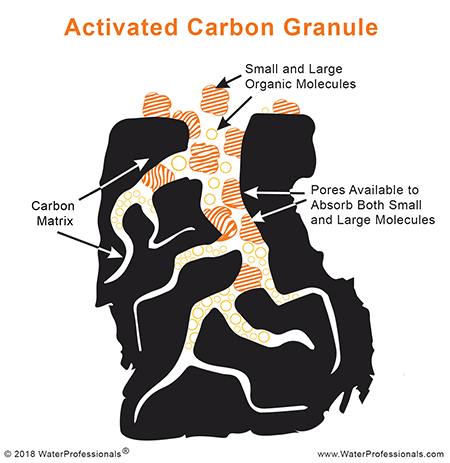
Figure 1. Molecular screening in the micropores of an activated carbon filter. (after G. L. Culp and R. L. Culp)
- Chemical Properties: The surface of an activated carbon filter may also interact chemically with organic molecules. Electrical forces between the AC surface and the chemical nature of some contaminants may result in ion exchange or adsorption. The activation process determines, to a large extent, the chemical properties of the AC filter, making the filter attractive to various contaminants. Different activation processes will yield activated carbon with different chemical properties. For example, AC that has the least amount of oxygen in pore surfaces will absorb chloroform the best.
- Contaminant Properties: Activated Carbon is best for use in filtering out large organic molecules. AC and organic molecules are similar materials, which means they will tend to associate with each other. This means organic chemicals will have a stronger tendency to associate with the AC filter rather than remaining dissolved in water. The less soluble organic molecules are, the more likely they are to be adsorbed. Smaller organic molecules fit the smallest pores and are held the tightest.
- Concentration: The adsorption process can be affected by the concentration of organic contaminants. For example, with chloroform removal one AC filter may be more effective than another at filtering high concentrations of contaminants, and less effective at filtering low concentration of contaminants. Consult with the manufacturer to determine how an activated carbon filter will perform at different concentration levels for a specific chemical.
- Water Temperature and pH: The rate of adsorption will usually be higher at lower temperatures and pH levels. Chemical reactions and chemical forms are closely related to water temperature and pH. In most cases, organic chemicals are more adsorbable as temperatures and pH levels decrease.
- Length of Exposure: The length of time in which the contaminant is in contact with the AC filter also influences the adsorption process – the longer the length of contact, the greater the number of contaminants that will be removed. A greater amount of active carbon and a slower flow rate will improve the effectiveness of the filtration process. Bed depth and flow rate are critical design parameters. Carbon filtration is often engineered to provide a specified residence time of water in contact with the carbon bed, referred to as empty bed contact time or EBCT.
Filtration Equipment
Activated carbon filters are similar to those used in multi-media filtration, except without the air scour step in the backwash process. Since certain organics require an extended exposure time to the filter to be removed, higher filter vessel side shells may be used to provide deeper carbon beds for extended reaction times. Carbon beds should be backwashed to help remove trapped silt, prevent packing and head loss, and to remove carbon fines produced by friction between granules.
As described above, there are a host of variables that must be considered in designing a filtration system and selecting the best carbon for the application. WaterProfessionals® have years of experience to help in supplying these systems. Contact us for additional information.
 Vietnamese
  English
  German
  Italian
  Japanese
  Korean
  Portuguese
  Russian
  Spanish
  Turkish